What Our Students with Dyslexia Really Need from Syllable Instruction

Our 5.17 episode talked about the strong opinions that exist around syllable types. Some people argue they’re essential, others say they’re confusing and unnecessary. At TIL, we think dyslexic students do benefit from explicit syllable instruction—but only when it’s used as a purposeful scaffold, not as a permanent crutch or a labeling exercise.
So, in the spirit of the question we’ve been asking at the end of every episode this season (what do dyslexic students really need?), let's talk about how and when it’s helpful to teach syllable types.
What do students with dyslexia really need from syllable instruction?
- They Need Strategies, Not Soundbites
For many students with dyslexia, single-syllable decoding can be solid, but everything falls apart with multisyllabic words. Basic phonics gives them starting tools, but explicit work with syllable types and morphemes provides the additional strategies needed for longer words.
Instead of, “Sound it out” or “Does that sound right?”—directions that often fail students who don’t yet have stable phonological or vocabulary foundations—syllable instruction gives them something specific to do:
- Look for vowel patterns
- Notice whether a vowel is open or closed
- Use syllable division patterns to make an informed attempt at pronunciation
This replaces haphazard guessing with a repeatable, reliable process.
- They Need Reduced Cognitive Overload, Not More
A common criticism is that teaching six syllable types and division rules is overwhelming. But, perhaps surprisingly, the purpose of explicit syllable instruction is actually to reduce cognitive overload, not add to it.
Because students with dyslexia often don’t intuit patterns in print, they benefit from a simple, predictable framework. When they can chunk a word like rabbit into manageable parts and know the /a/ is likely short in a closed syllable, they’re not juggling as many unknowns at once.
In a well-structured lesson grounded in Orton-Gillingham and structured literacy principles, routines are highly predictable. That predictability frees up working memory so students can focus on applying the strategy, not on figuring out what their teacher is asking them to do next.
- They Need Syllables as a Bridge to Spelling and Morphology
When we talk about syllable types, it’s easy to think only about decoding. But it’s important to remember that syllable knowledge is also deeply tied to spelling and morphology.
Syllable instruction helps students:
- Recognize likely vowel sounds in each chunk
- Apply patterns to spelling longer words (like knowing when a vowel is more likely to be short vs. long)
- Build toward breaking words by meaning units (prefixes, roots, suffixes) while still using syllable knowledge to support pronunciation
This isn’t about memorizing six boxes on an anchor chart. It’s about understanding how English words are organized and giving students a framework that carries over into writing and vocabulary work.
- They Need Us to Stop Overusing the Scaffold
Where does syllable instruction go wrong? When we turn a powerful scaffold into a compliance task.
Syllable division is a tool for:
- Reading and spelling unfamiliar or challenging words
- Supporting pronunciation when there’s no oral model to fall back on
If a student can already read and write the word accurately, they don’t need to keep coding it. At that point, insisting on constant marking and labeling becomes busywork that understandably feeds the “syllables are a crutch” criticism.
- They Need Us to Ask Better Questions
Instead of blanket statements like “don’t teach syllable types,” we need to think about guiding questions, like:
- For which students? — Is this a whole-class statement, or are we talking specifically about learners with dyslexia who are struggling with multisyllabic words?
- In what context? — Intervention? Core instruction? Small-group support? The needs and intensity look different in each setting.
- How is the instruction actually being implemented? — Is syllable work tightly connected to reading and spelling, or has it drifted into isolated labeling and rule-recitation?
When you sit beside a student with dyslexia every day, the nuance becomes impossible to ignore. Their progress depends less on whether syllable types are present at all, and more on how thoughtfully and flexibly we use them.
TL,DR: What Do Our Students With Dyslexia Need?
What our students with dyslexia really need from syllable instruction isn’t another extreme: not “never teach it,” and not “teach it forever.” They need:
- Clear, explicit strategies for attacking long words
- Predictable routines that lower cognitive load
- Strong connections to spelling, morphology, and meaning
- A scaffold that’s gradually lifted as they gain independence
If we can keep those needs at the center, and resist turning syllable types into either a villain or a magic fix, we’re far more likely to give our students what truly matters: a flexible, confident way to approach the big words that used to stop them in their tracks.
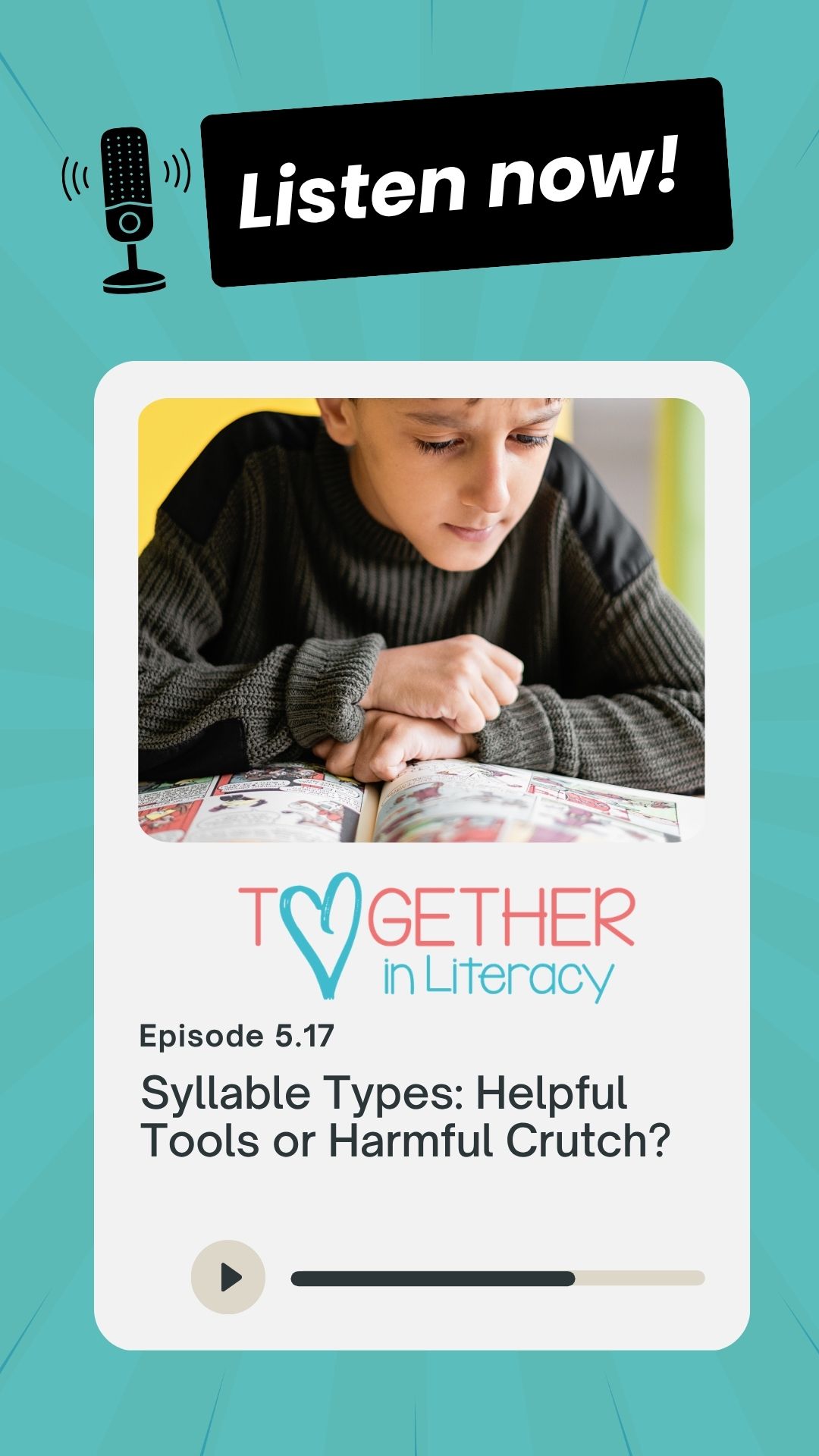
Interested in hearing more? Listen to our full episode 5.17 Syllable Types: Helpful Tools or Harmful Crutch?
Looking for strategies and resources?
Sign up for our newsletter for news, resources, and freebies delivered straight to your inbox.
We hate SPAM. We will never sell your information, for any reason.
